Thus far, U.S. agriculture has fairly mixed reviews about President Donald Trump. Despite massive support from rural America in his election, the president has been generating significant concern with crucial agricultural policies, most notably with regard to international trade.
Trade, of course, is absolutely essential for the economic sustainability of virtually every major U.S. agricultural commodity. The President?s very aggressive stance in opposition to beneficial trade deals for agriculture including the Trans Pacific Partnership (which President Trump withdrew from) and the North American Free Trade Agreement (which President Trump threatened to withdraw from) were making U.S. agriculturalists increasingly uneasy, if not outright angry.
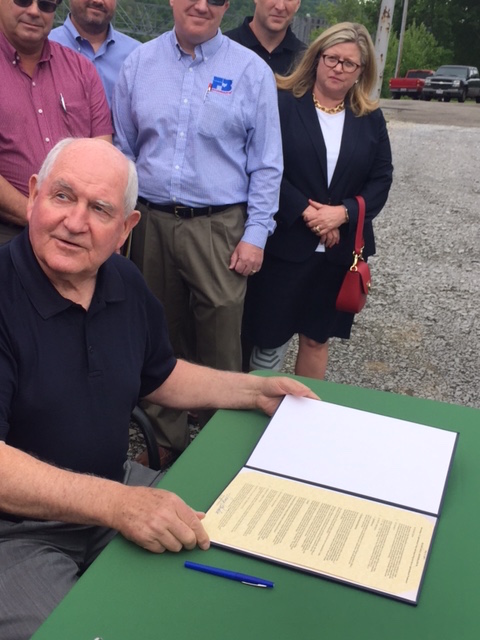
The Trump Administration directly addressed this and other growing agricultural concerns in a Cincinnati press conference with newly confirmed U.S. Department of Agriculture Secretary Sonny Perdue.
?In order to advance agricultural trade, USDA intends to create an Undersecretary for Trade and Foreign Agricultural Affairs and realign the Foreign Agricultural Service to report to the new Undersecretary,? Perdue said. ?Our plan to establish an undersecretary for trade fits right in line with my goal to be American agriculture?s unapologetic advocate and chief salesman around the world. By working side by side with our U.S. Trade Representative and Secretary of Commerce Wilbur Ross, the USDA undersecretary for trade will ensure that American producers are well equipped to sell their products and feed the world.?

Photo by Dale Minyo.
In the last farm bill, Congress provided direction for USDA to examine options for reorganizing the international trade functions at USDA and potentially creating the new Undersecretary for Trade and Foreign Agricultural Affairs. The new trade-focused position at the USDA is part of a larger department-wide reorganization. Under the existing structure at USDA, the Foreign Agricultural Service (FAS), which deals with overseas markets, and the Farm Service Agency (FSA), which handles domestic issues, are housed under one mission area, along with the Risk Management Agency (RMA). Perdue pointed out that it makes much more sense to situate FAS under the new undersecretary for trade, where staff can sharpen their focus on foreign markets.
Perdue said that the reorganization also includes the formation of a new Farm Production and Conservation mission area with a customer focus that meets USDA constituents in the field.
?To create a customer-focused culture of public service and improve service delivery to agricultural producers, USDA intends to create an Undersecretary for Farm Production and Conservation and realign the Farm Service Agency, the Risk Management Agency, and the Natural Resources Conservation Service to report to the renamed Undersecretary,? Perdue said. ?USDA also intends to realign the Rural Development agencies to report directly to the Secretary to provide additional visibility for the investments being made in rural America.?
Though a reduction in USDA workforce is not part of the reorganization plan, with big budget cuts proposed by the Administration the reorganization efforts will likely ultimately facilitate doing more with less.
?USDA remains committed to focusing our constrained resources where they will be most effective ? on pushing our record-breaking pace of trade and ensuring that opportunities exist throughout the country for Americans to participate in a transformational global economy. In particular, USDA continues to negotiate and support strong trade deals that will open up markets and help farms, ranches, forests, and production facilities grow, create jobs, and increase wages,? Perdue said. ?This plan also details additional changes to our Department that will improve the effectiveness of USDA efforts to meet the needs of agricultural and forest managers and demonstrate increased accountability to the American taxpayer.?
Click HERE to view the report on the USDA website.