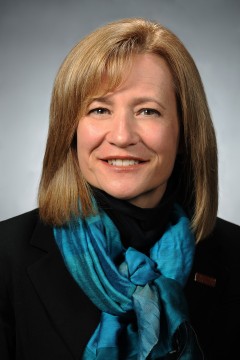

A conversation with?
Cathann Kress, Dean of the College of Food, Agricultural, and Environmental Sciences
OCJ: This spring, you started in as the new dean. How have things gone since you got started on the job?
Cathann: It was good timing coming into a position like mine. At the end of the academic year everything comes together. You really get to be there when you can see the best of everything happening. We gave out faculty and staff awards and had commencement. It is a great time to come in and see all of the good stuff happening. I have had opportunities to talk with alumni and I have been at the Statehouse three times already and had a chance to dive into some of the budget discussions going on. I have been delighted at that opportunity as well.
OCJ: What are some of the area of the state budget affect Ohio agriculture and the College of Food Agriculture and Environmental Sciences as a whole?
Cathann: We are very appreciative of the attention that has been given to the lines that we have that impact us directly. One of those is for OARDC and research in general. The House has recommended an increase for OARDC and we are very appreciative of that. The research that is being done is incredibly important to not only agriculture but also peripheral and related industries. We really need to stay at the forefront of that work. The other line, of course, is Extension. Extension throughout the state has such a wide portfolio of programs including 4-H, which is an incredibly important way to reach out to the young people. All of the Extension programs form an important network that allows us to make sure we are getting the research-based information out to all of our citizens ? serving all Ohioans, not just those on our campuses. Those are both really important lines we are watching in the state budget.
OCJ: Are there things that need to be pushed a little bit more in the College? Are there ways Ohio State needs to be more competitive?
Cathann: In our research and academic programs we have a tremendous amount of talent and expertise and we have really strong students across the whole portfolio. The breadth is really impressive. That is one of the things that was appealing to me as I considered this position. But it doesn?t appear to me that we have the level of depth that I would like to see in some of our program areas. When you look across the nation at the top departments, while everyone knows we have really good programs, we don?t often end up in that top tier. To me that is a bit frustrating because I know we have the talent and resources. I think what it really boils down to is that we haven?t had the focus. I want to make sure we have that focus so we are able to move on some of the priorities in a way that really starts to position our college in that top tier where I think it belongs.
We always want to be at the forefront in our portfolio of offerings we have for students so when they leave us they will be able to step into the workplace and really be able to bring the most technological savvy possible. We need graduates who know about state-of-the-art to be accountable to businesses and our citizens. That is important to us.
OCJ: What are your thoughts on improving facilities for the College?
Cathann: Facilities are one of those things that are constant. Growing up on a farm, one of the things my dad always used to say was, ?In agriculture no matter where you sit you?re always looking at work to be done.? It is like that when you?re a dean too. No matter where you are sitting there is always work to be done, particularly with our facilities. People who aren?t as familiar with agriculture think about agriculture as being agrarian and not really cutting edge with technology. We know, though, that this is the world of agriculture and it will be even more so in the future. You are going to see more use of data and technology. The big challenges ahead of us in agriculture really mean that we are going to have to continually upgrade so our research can address these things. We have got to keep pace with the technology, facilities and the equipment or we just won?t be able to answer those challenges.
OCJ: What are some key challenges moving forward?
Cathann: Water quality and health in general are important challenges. There are three components of health: human health, environmental health and animal health. But in my mind they really are part of one big circle. You don?t have one without the other. We really need to get beyond just thinking about human health. When we think about health, we think about hospitals and medical communities and place less emphasis on environmental and animal health. In my opinion those are equally important if we are going to preserve our health in the future.
And, somewhere along the line we ended up with a gap or divide between urban areas and the general public and agriculture. What are we doing in agriculture and can we be trusted? How do we communicate the stories in agriculture to reassure consumers that nobody cares more about the land and animals than we do? I think that is another role for us to play at the College. When you look at the misinformation out there, I think we have a responsibility to help make sure that we are transparent in farming. I think we have been silent for too long and people made assumptions and got misinformation. We have a role to play in making sure the public understands our industry better.
Also, the USDA just issued a new report that in the future all of the colleges are only going to account for 61% of the jobs that we anticipate will be in the ag industry. That is a huge shortfall. How are we going to address that shortfall? We are already looking at the challenge of feeding the world and research is critical in that area. We are falling way behind in investments being made into agriculture and ag research. If we are only turning out 61% of the grads of what we know the workload is gong to be, that will start to be a pretty pressing workload too.
OCJ: You have worked in several jobs around the country. What is the opinion and reputation of Ohio State from the outside looking in?
Cathann: The Ohio State University has a very solid reputation in terms of a strong community within the faculty and students as well as among the network of alumni and donors. That is a tremendous asset. As far as the reputation of the College, as I said earlier, the resources are there and it is always in the top 10, but as far as the very elite group of the top five often it doesn?t pop up there in the different disciplines and departments. That is something I am hoping to change. The talent is there and we need to leverage that talent and opportunities in ways that get recognized nationally. I am very optimistic we can address that.
OCJ: What are your thoughts on the Agricultural Technical Institute?
Cathann: ATI was another one of the reasons I was interested in this position. There are several positions out there for deans but there are not many of them that have this broad portfolio of educational opportunities that we can make available to students. ATI is right at the top with being able to offer these kinds of opportunities with associate degrees here in Ohio. Not every learner learns the same and not all of them need the same opportunities. I am very proud of the fact that we have a whole variety of ways you can come in as a student and learn the different things you may be interested in learning. Whether you start at ATI or in Columbus or distance learning, we want to make sure we can tailor an educational program that is going to meet your needs and at the end of it you will be able to go out and get the job you are looking for. I think we have more opportunities to do that here at Ohio State than most other universities do and that makes us highly competitive.