

If you are looking for something different to do on a September weekend, consider taking a self-guided tour of Iowa’s historic barns.
The Iowa Barn Foundation is holding its 26th Annual All-State Barn Tour on Saturday and Sunday, September 19-20, featuring over 100 barns across the state that will be available for visiting inside and out from 9-5 both days. Iowa is proud to host the largest barn tour in the world!
The fall tour highlights barns that have received a restoration grant from the foundation and those that have received an Award of Distinction or Preservation Award for restoration funded by the owner. Many of the owners will be on hand to share their memories and regard for the structures and answer your questions.
This year’s tour includes 108 stops, including 12 barns which are on the tour for the first time. If you have only seen barns from the road, you are missing out on the true beauty which lies within the walls. That is where you will see the true craftsmanship that went into the construction of these “cathedrals on the prairie.” The tour includes a record 16 round barns, which are some of the most rare and unique barns in the state. This is great multi-generation weekend activity for the whole family to experience history “in the real.”
The self-guided fall tour is free and open to the public, made possible by member donors. An interactive online tour guide can be found at iowabarnfoundation.org/barn-tours. Member donors receive the foundation’s spring and fall magazines in their mailboxes filled with barn photos and stories as well as a printed tour guide and map. New members should sign up by August 31st to ensure delivery of the fall magazine before the tour. Learn more about membership at iowabarnfoundation.org/product/membership. Questions can be emailed to iowabarnfoundation@gmail.com.
As a volunteer-led non-profit, the Iowa Barn Foundation’s goal is to maximize member donations to provide restoration grants to save the state’s historic barns. Since being founded in 1997, the foundation has given out $2.6 million dollars in grants to help save over 300 barns. The foundation does not receive any government funding, so it is 100% dependent on private donations to fund its programs.
*************
Three barns that are new to the tour in 2026 and may be of interest are listed below.
Ogden Barn (New for 2026), 15170 NE 120th Ave, Maxwell (Polk County)
Located on a scenic gravel road, this gambrel roof barn was likely built between 1910-1920. The edge of roofline features a Dutch flair which helped to cast rainwater away from the siding. The interior features wooden milking stanchions, four stalls for draft horse teams, two grainaries, and a large haymow. Restoration in 2025 included foundation stabilization, window replacement, roof replacement, and a fresh coat of paint. The barn will soon be home to sheep, cattle, and horses (Restoration Grant).
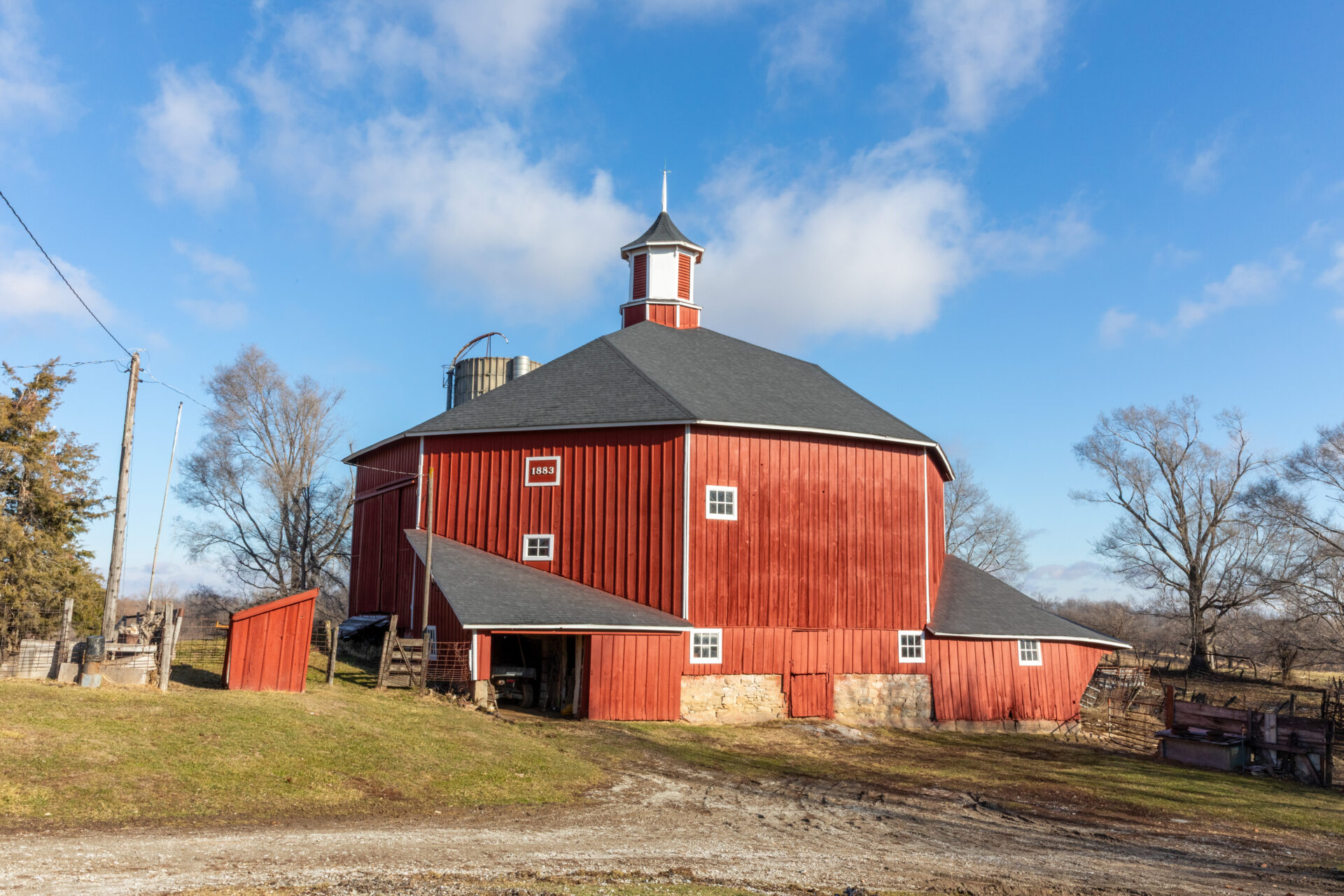
1883 Roberts Octagon Barn (New for 2026) – 4715 Kansas Ave SW, Iowa City (Johnson County)
John and Ann Roberts were proud of their newly completed octagon bank barn in 1883, built on a farmstead settled by the Roberts family in the 1860s. The bank barn features an unusually modified hip-roof form and the non-circular interior arrangement. The basement level features horse stalls on one side, cattle pens on the other side, and two rows of dairy stanchions in the middle section. The haymow level features oat bins and a small corncrib. This 8-sided barn stands on a foundation of limestone cut 14 to 16 inches in width. Each one of the sides is 26 feet long, and the diameter of the barn is 61 feet. The lean-tos were original to the barn and used for added storage and shelter for livestock. Rustic hand-hewn beams frame the interior of the barn. (Award of Distinction, Heritage Farm).
Hempstead Barn (New for 2026) – Northeast corner of Simon Road & Highway 151, Fillmore (Dubuque County)
This prairie style barn was built in 1896 for Michael and Mary (Whalen) Seery. It is a small barn, 24 feet wide, 48 feet long and 33 feet tall. Josepf Kofmehl from Farley, IA constructed the barn for Seery on this 40-acre farm. The farmhouse on the property was removed in the 1970s when Highway 151 was widened. The interior of the east side of the barn contains wood stanchions for milking cows and a pen for calves. The west side has four horse stalls. The interior of the barn is original. The wood floors in the stalls are well-worn but intact. There is a corn crib attached to the back of the barn. The Hempstead population sign on the barn is in reference to the original village name given when the area was platted in 1856-57. The village later received the Fillmore name that it is known by today (Award of Distinction).

