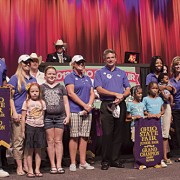
Fifty years ago, it started with a dream to support the Ohio State Fair?s youth livestock exhibitors. Today, 422 champions have been honored and more than $6.4 million in sales have been generated by the Ohio State Fair Sale of Champions.
?We?re just trying to get them money to go to college and help them buy some farms,? said Gov. Jim Rhodes to Ed Johnson in a 1982 interview.
Rhodes was the mastermind behind the event that would help build the legacy of Ohio livestock exhibition on a national and international stage ? the Ohio State Fair Sale of Champions. Rhodes recognized the hard work, long hours and vast leadership potential of the top livestock exhibitors at the Ohio State Fair and he wanted everyone else to do the same. He also wanted to establish a way to help those young exhibitors benefit from their incredible achievements financially. With these goals in mind, Rhodes teamed up with the Ohio Expositions Commission and well-known auctioneer Merlin Woodruff, who had been selling livestock at the Ohio State Fair since 1952.
?Everybody connected over there, the commissioners and all, wanted to make it central for the champions. Before that we were selling the champion hogs in the hog barn, we were selling cargo lots under the railroad tracks, and we were selling the champion steer in the Davey Building,? Woodruff said in an interview with Ed Johnson in 1998. ?It was all scattered and some people would see one but wouldn?t see the others.?
The first Sale of Champions in 1968 was designed to provide a one-stop event to showcase the fair?s top youth livestock exhibitors, provide an attraction to promote agriculture and attract the interest of buyers who could afford the type of funding required to reward excellence.
?The competition at the Ohio State Fair is tough,? Woodruff said. ?There has to be a certain amount of luck because when you get in that top 10, it is tough. Those kids realize that that calf, or that lamb or that barrow has to be at 12 o?clock, not a quarter to 12. It has to be at 12 o?clock when it goes in the show ring. If they do anything in life, they?ve got to learn there is a certain time things have got to be right.?
Gov. Rhodes was a relentless supporter and promoter of the event right from the start through his first stint as governor, and then again when he was re-elected for terms beginning in 1974 and 1978. His dedication to the Sale of Champions is clear in the dollar figures during his tenure, which regularly broke records thanks to his hands-on involvement and literally getting out in the crowd to encourage the buyers to make higher and higher bids.
When he returned after four years away from office, it was apparent that the governor?s dedication to the Sale hadn?t wavered.
?Gov. Rhodes was back in office and that was his big thing ? the State Fair and the creation of the Sale of Champions,? said Mike Bumgarner, CEO of United Producers, Inc., who had the grand champion steer at the 1975 Ohio State Fair that sold for $26,680. ?It was a tremendous experience and I was fortunate to be there at a time when Gov. Rhodes was there and behind it 100%. He set the pace.?
Like so many families showing livestock in Ohio, the Bumgarners had worked for years with their focus on the premier event at the Ohio State Fair.
?My brothers and I were fortunate that we had been semi-successful at the county level and at that time there were not all the jackpot shows that we have going on today and the ultimate goal was the State Fair,? Bumgarner said. ?I had been to the Sale of Champions but not as a participant, but I knew that is where you wanted to get to. I can remember when they sold the steer out under the viaduct. The Sale at the time I sold was in Cooper Arena. There were a lot of butterflies. Those crossbred steers then were pretty high-strung, a little different from today where they are actually breeding for a better disposition. We took those on back then and had to deal with them. The Ohio State Fair Band was part of the Sale then. I can remember Merlin actually had to stop the band one time because those cymbals were clashing and the steer was getting agitated. He thought I was going to get taken out of the sale ring pretty quick by the steer.?
The Sale of Champions is always entertaining because there was ever-present uncertainty with youth, their animals and unpredictable buyers.
?The Sale was still new then and there were times when the auction got completely thrown off track. One year someone in the back started trying to bid and they had to stop the sale to find out if they should take her bid or not,? Bumgarner said. ?That made it unpredictable and exciting, but from the auctioneer?s standpoint it threw a wrinkle into things, not knowing if it was a legitimate bid or not.?
Bumgarner still fondly remembers his Sale of Champions experience as a young exhibitor.
?It was the highest-selling steer at the time. It was just over $26,000. The Sale is the culmination of hard work. A lot goes into getting to that point,? Bumgarner said. ?The money is nice but it is not about the money. It is about the sense of accomplishment. It is the competition, the recognition. The money is really a minor part of it.?
Nonetheless, those dollar figures kept increasing through the years thanks to the generosity of buyers, said Sale of Champions auctioneer Johnny Regula. Regula started working with the Sale after being asked by Woodruff in 1991. In 1998, Woodruff ceremonially handed the gavel over to Regula mid-sale. When the Ohio Expositions Commission voted to add the turkey, goat and dairy exhibitors in 2011, Kevin Wendt was added to the team. All have pointed to the generosity of the buyers as the key to the Sale?s success.
?We have been very blessed with buyers,? Regula said. ?One of the reasons the Sale continues to grow is that Ohio is one of the first states to put a Sale of Champions together and put it on television. This was production agriculture?s one day a year to promote production agriculture and the buyers realized the value of participating because they were going to be on TV and could spread their message to way more people, and it was for a good cause. To me, the buyers are what makes this thing click. We?ve had individuals, small companies, big companies, restaurants, grocery stores, gas stations, banks, car dealers and about everyone you can imagine buying. That is what it takes. Buyers keep this going.?
And they do not just buy; they buy with fanfare.
?I can remember the year Bob Evans brought a bushel basket of dollar bills. The hog brought $13,000 and Bob Evans reached in his pocket and pulled the bill out so it was $13,001,? Regula said. ?Every time Wendy?s bought an animal Dave Thomas always added $256 to it. The reason is back in the day when they first started, they advertised that there were 256 different ways to serve a hamburger.?
With Woodruff at the block, the early years of the Sale of Champions only included steers, hogs and lambs.
?It took 10 years before they added chickens in 1977. For old guys like me, we sold everything by the pound. In 1971, some guy out of the crowd bought the lamb for what he thought was $4, but it was really well over $400,? Regula said. ?Well, it is hard to sell chickens by the pound when they only weigh 21 pounds for the whole pen. That is when they chose to go by the total dollar amount. That was the biggest change as far as how we call the bid.?
The original tag team of Woodruff selling the animals and Gov. Rhodes goading buyers to spend just a bit more proved to be incredibly successful. When the promotional efforts of farm broadcaster Ed Johnson were added to the mix, the Sale of Champions became an annual highlight for not only the youth exhibitors and their families, but also all of Ohio?s production agriculture.
?The evolution of this sale without question took the foresight of folks like Gov. Rhodes, Merlin and Ed Johnson. They broadcast that sale to all of the what we now call the soccer moms around the region. The general public loves it,? Regula said. ?Ed Johnson is the one who promoted this in the right way that people could appreciate production agriculture.?
Ohio?s leadership with this idea has continued to set precedents through the years. The big dollar amounts generated in the Sale of Champions encouraged the Ohio State Fair to take steps to spread the funds out to more of the exhibitors with the creation of the first-of-its-kind Youth Reserve Program in 1995. The program is funded by setting caps on the amount the Sale of Champions exhibitors receive with the rest of the sale proceeds going to provide funding for scholarships, 4-H, FFA and other youth programming and to reward the top overall exhibitors in the skillathon (a test on the various components of their livestock project), showmanship and the junior market show. To date, this program has distributed more than $3.2 million for approximately 33,600 youth exhibitors.
State Fair manager Virgil Strickler paved the way for the new program.
?I believe that the way we have done this has helped the livestock industry stay afloat with these projects. It has spread things out financially. It has also helped the universities because the youth come there more knowledgeable than ever before,? Strickler said. ?I got a call from a mom and she told me that her kids were on the family vacation studying for their skillathon. I believe that we have really come a long way. Look at what we have done in terms of the money being raised from these buyers. The buyers have bought into the fact that we are helping all of these kids every year with the Youth Reserve Program. And, when the buyers contribute they have to present the check the next year, and that brings them back to the Sale. The buyers love it because we are getting more money out to more youth. The backing we have has produced a great system of the Youth Reserve Program and I believe it will keep growing.?
For many years the Sale of Champions was held in the Cooper Arena mid-fair, but that has since changed.
?When I came on board in ?93 we were still in Cooper for the Sale. Then we moved it to our brand new building in the Voinovich Livestock and Trade Center. It went over really well but it was really hot in that place. The next year we decided to spruce it up a little more and move it to the Celeste Center,? Strickler said. ?The Celeste is an entertainment venue and we tried to make it as fantastic as we could with the lighting and sound and the air conditioning. It put the icing on the cake when we put it in there. Then when we went from 17 to 12 days in 2004 we put the Sale at the end of the fair to bring it all together as the grand finale of all livestock shows.?
Ohio has been revolutionary with the creation and execution of the state?s Sale of Champions, often the serving as the subject of educational trips so those fairs could recreate it.
?Looking back at the rich history we?ve built upon and the evolution the Sale of Champions has undergone in five decades, I speak for myself and the Ohio Expositions Commission as a whole when I say we couldn?t be more proud of the work we?ve done,? Strickler said. ?We?ve brought unity to the various species with a centralized auction filled with fanfare and putting our youth in the spotlight.?
As it was in 1968 and in Bumgarner?s days in the show ring, the Sale of Champions remains the pinnacle of Ohio youth livestock exhibition.
?The Sale is really elevating the exposure of what those exhibitors do day in and day out to succeed. They are recognizing every kid in 4-H and FFA that works with livestock projects. It gives the general public a sense of the work ethic needed to get there, not only to the winner?s circle but just to participate. These projects take a lot of time. The general public does not have a good understanding of what all is involved with that. Having a venue like the Sale of Champions that allows the industry to go out and recognize the youth and their work ethic is a real benefit not only to the individual but the industry as a whole,? Bumgarner said. ?There were so many people along the way who really understood the importance of that event. The list goes on and on. The Sale of Champions at the Ohio State Fair set a high bar and example for the whole state fair circuit and livestock show circuit around the country and has been the lead on many fronts. They continue to be the leaders out there.?
With the 50th Sale of Champions on Aug. 6 at 2 p.m. at the Ohio State Fair, the future of the event is bright, just as when Gov. Rhodes responded to a question about its future in 1982.
?It is going to get bigger. There is too much momentum for anybody to stop it. It is going to grow. It is going to expand. They are going to innovate. They are going to invent. They are going to do everything possible to make it greater,? Rhodes said. ?The seed has been planted and it is going to grow.?
Here are some great photo highlights through the last 50 years provided by the Ohio State Fair and the OCJ archives.