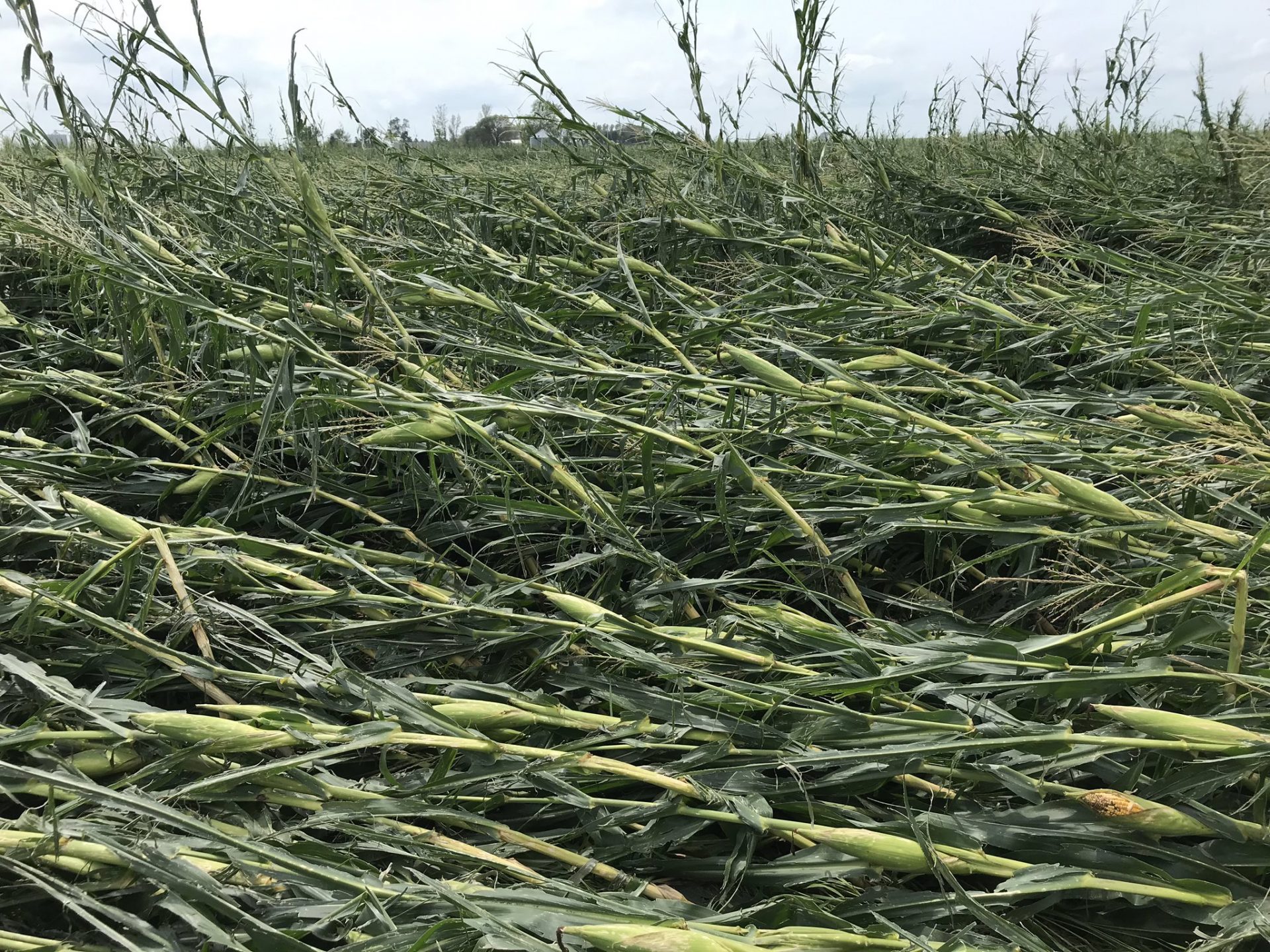
We continue to learn more information about the derecho storm system that wreaked havoc across Iowa and other parts of the Midwest on Monday, August 10th.
Cleanup continues in many areas of Iowa from the damaging windstorm and farmers are still assessing their flattened or heavily damaged crop fields. Iowa State Climatologist Justin Glisan provided insight into the derecho event during a weekly ISU Extension drought webinar on Thursday. He says the derecho held together for 770 miles over 14 hours before losing strength as it entered western Ohio.
?The August 10th derecho event formed in the early morning hours in southeastern South Dakota and moved into Nebraska as a pretty put-together line of thunderstorms,? Glisan said. ?It crossed the border into Iowa at about 8 or 9 a.m. and some severe thunderstorm warnings were issued along that line. We weren?t necessarily sure that line would hold together. It wasn?t until it moved into central Iowa that we really started to see the thunderstorm complex strengthen and those wind speeds start to pick up. This was as the derecho was starting to consolidate.?
Some of the highest recorded wind speeds from the storm were 106 miles per hour at a personal weather station two miles west northwest of Le Grand, 99 miles per hour at the Marshalltown Airport, and 90 miles per hour south of Chelsea. Dennis Todey is USDA?s Director of the Midwest Climate Hub in Ames. He says the damage to crop fields in Iowa could be seen via NASA Satellite in space.
?The area that goes around Des Moines starts around Carroll and then works southeast around the Des Moines area,? Todey said. ?It worked down around Pella and that region. The area on top starts at about I-35 north of Ames and then heads east from there. The third (impact area) starts around Marshalltown and worked eastward through the state. We are skewed a little bit by clouds in the southeast part of the state. We don?t think there was quite as much damage down there, but we are still trying to determine that.?
Glisan noted that ?derecho? is derived from a Spanish word that can be interpreted as ?direct? or ?straight ahead.? The term was coined by Dr. Gustavus Hinrichs at the University of Iowa in the late 1800s.