

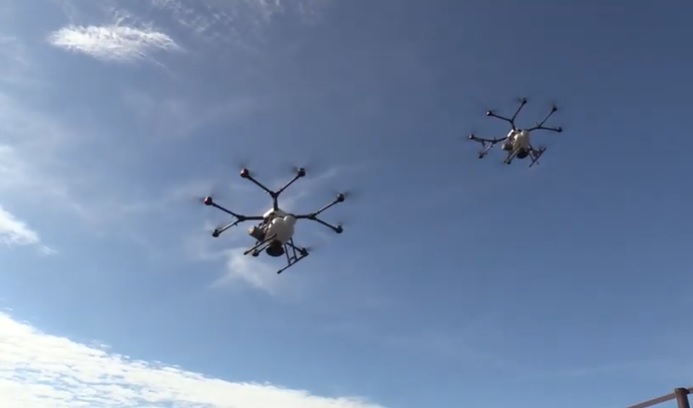
Iowa City-based Rantizo is addressing both the field needs of farmers and the business needs of custom applicators through the use of drones.
INTERVIEW: Benjamin Etsinger – Rantizo regional sales manager
Drone spraying is relatively new to the agricultural industry, says Rantizo regional sales manager Benjamin Etsinger. Rantizo uses DJI drones at the core of its agricultural drone spraying platform. DJI is the market leader in the drone manufacturing industry and has over 70% of the market share worldwide.
?When it comes to the dry application side, interseeding cover crops between 7-15 pounds is something we can do pretty efficiently and really well,? said Etsinger. ?The other piece on a dry application side could be when it comes to site specific application of a micronutrient deficiency. We can load up our dry spreader with micronutrient manganese, a dry granular zinc or boron, and go put it in areas that are showing micronutrient deficiency symptoms. When it comes to the liquid side, our options are a lot more vast. We can talk about site specific application for whatever it needs. Maybe there is an insect infestation in only certain areas of the field. That?s what we do well is site specific application.?
Etsinger says Rantizo drone technology can be used for virtually any crop, and is particularly favorable for high-value, low-acre specialty crops, such as hemp, berries and vineyards. Spot spraying, site specific applications, and hard to access areas are an excellent way to utilize drone applications for high-acre, commodity crops.
?Whether it be an airplane, helicopter and/or a traditional ground rig that has 90- or 120-foot booms, all over the Midwest we are going to find small awkward acres that maybe are 8, 12 or 15 acres that are oddly shaped that a ground rig isn?t necessarily efficient at making that application, or an airplane just simply doesn?t feel safe making that application from a flight pattern standpoint,? said Etsinger. ?To dispatch our drone to those acres, not only are we making the airplanes and helicopters more safe, but we?re also making the ground rigs more efficient. They can stay in the fields they are cut out to do and cover more acres at the end of the day if we take the acres that they are not necessarily designed to be efficient in.?
However, Etsinger explains Rantizo can tackle large fields as well.
?If we want to cover large acres, which a lot of our contractors were doing whole fields the last six weeks during fungicide season and they were successful at it,? said Etsinger. ?The way we attack larger acres is we can actually two and/or three drones to a single remote control. We can dispatch those, for an easy example, for a 30-acre field. We?re going to assign drone A to 10 acres, drone B to a middle of the 30 acres to another 10, and then drone C to the far right 10 acres. Press ?go? and all three of them are going to go make applications at once.?
Drone spraying is allowed in the U.S. with proper licensing and certification. These requirements are mandated by both the FAA and state agriculture and business departments. Additional permission is required by the FAA for carrying hazardous material with a drone and swarming multiple drones.
For more information, visit rantizo.com. Etsinger made his comments to the Iowa Agribusiness Radio Network at the 2021 Farm Progress Show in Decatur, Illinois.
